In an AI-First Engineering Organization, Quality Is the Competitive Advantage
July 23, 2026
Sean Hollender, MBA, MS-CIS, PMP
Why quality assurance and UX design are becoming more valuable in AI-powered software development
The more I use AI to build software, the more convinced I become that the center of gravity in engineering is shifting.
AI can now generate complex Python scripts, scaffold JavaScript applications, configure environments, create interface components, and write test cases at a speed that once would have required significantly more time and a much larger team.
That capability is extraordinary. But it also exposes a new constraint.
The most important question is no longer simply: Can we build it?
Increasingly, the questions that matter are: Did we build the right thing? Does it work under real-world conditions? Can people actually use it? And how do we prevent it from breaking tomorrow?
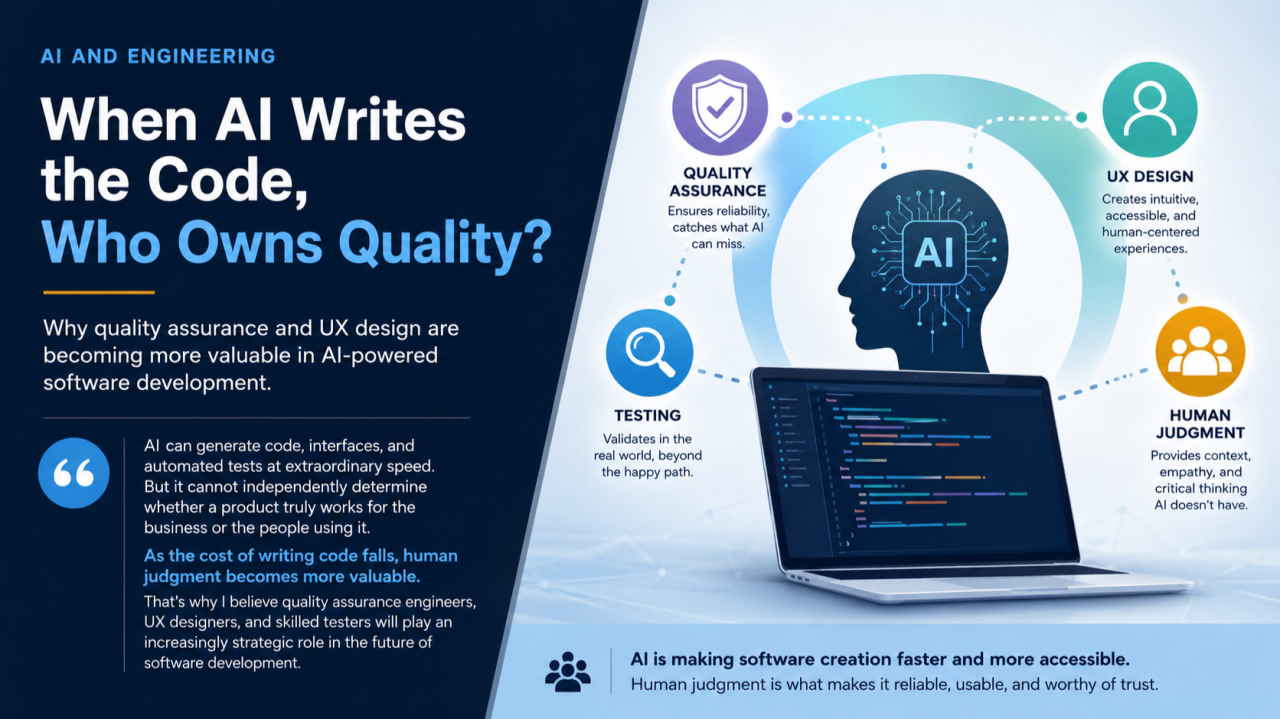
This is why I believe quality assurance engineering and UX design will become more important—not less—as AI takes on a larger role in software development.
AI can generate tests. It cannot independently define quality.
AI is capable of writing unit tests, smoke tests, regression tests, and automated test scripts. Those capabilities are valuable, and they will continue to improve.
But generating tests is not the same as understanding what needs to be tested.
A test suite is only as good as the assumptions behind it. AI can generate an implementation and then produce tests that confirm its own interpretation of the requirements. The code may pass every test and still fail to satisfy the actual business need.
It may handle the expected path while missing important edge cases. It may meet the literal wording of a specification while missing its intent. It may function technically while creating an experience that is confusing, inaccessible, or impractical.
True quality assurance asks deeper questions:
What is the system not doing?
Where does the behavior diverge from the intended outcome?
What conditions could cause it to fail?
Which capabilities must never regress?
What will a real person experience that is not obvious from the code?
These questions require curiosity, skepticism, context, and human judgment.
A strong quality assurance engineer does not necessarily need to personally correct every defect. The critical skill is being able to identify the problem, explain why it matters, reproduce it, and define the conditions that will prevent it from returning.
Once the problem is clearly articulated, AI may be very effective at helping implement the fix. But identifying the right problem remains a distinctly valuable skill.
Independent evaluation still matters
The software industry has spent years moving toward a model in which engineers are expected to own nearly every aspect of quality. Engineering ownership is important, and developers should absolutely test what they build.
But ownership and independent evaluation are not the same thing.
When someone has spent days building a system, that person naturally becomes familiar with its assumptions. They know how it is supposed to work. They know which sequence of actions leads to the expected result. That familiarity can make it difficult to see the product the way a first-time user will see it.
It is similar to preparing a meal: the person who cooked it may understand every ingredient, but that does not automatically make them the most objective judge of the final experience.
AI has an even greater version of this limitation. It can evaluate whether the implementation matches the instructions it received, but it does not live with the consequences of the experience. It does not become frustrated by an unclear workflow. It does not lose trust when a button behaves unexpectedly. It does not feel the cognitive burden of navigating a poorly organized interface.
Quality assurance provides the independent perspective needed to close that gap.
UX design becomes a force multiplier
The same principle applies to user experience and visual design.
One of the first things I now want when building software with AI is a clear brand guide or design system. That guidance might include typography, spacing, colors, component behavior, accessibility standards, interaction patterns, and examples of the intended experience.
Once those standards are clearly documented, AI can apply them with impressive speed and consistency. A machine-readable design system can become part of the development process, giving the AI a repeatable set of instructions every time it generates a screen or component.
This is a major opportunity. Historically, translating design intent into code could be slow, inconsistent, and highly dependent on communication between designers and developers. AI can reduce that friction considerably.
But AI still needs someone to determine what the design system should be.
That requires taste, empathy, brand understanding, and knowledge of human behavior.
AI is an aggregate of taste, not a determinant of taste.
It can synthesize patterns from what has already been created. It can recommend familiar layouts and reproduce established conventions. But it cannot reliably decide what will make a particular product distinctive, trustworthy, intuitive, and appropriate for its audience.
Humans establish those principles. AI helps scale them.
Technical correctness is not the same as usability
The limitations become especially clear when AI generates user interfaces.
An AI system may create a button with white text on a white background. From the model’s perspective, the button exists. The label exists. The code is valid. The interface structure may be technically correct.
A person looking at the screen cannot read it.
The AI can parse the component because it does not experience the interface through human eyes. It can understand the underlying structure without recognizing that the result is effectively unusable.
The same issue appears in more subtle ways. An interface may contain every required capability but place them in an unintuitive order. A workflow may function but require too many decisions. Individual screens may appear reasonable while the overall user journey feels inconsistent.
UX designers and usability testers identify these gaps because they evaluate the product as an experience—not merely as a collection of functioning components.
That is the difference between software that technically works and software that people can confidently use.
The role of engineering is evolving
None of this means that software engineers are becoming unnecessary.
It means the role is evolving.
As the cost of producing code decreases, more value shifts toward problem definition, architecture, integration, security, risk management, product judgment, and validation. Writing code remains important, but it becomes one part of a larger responsibility.
The strongest AI-enabled engineering organizations will not simply generate more code. They will build better systems for deciding:
What should be built
How success will be measured
What risks must be controlled
How the experience should feel
How quality will be continuously verified
In that environment, QA engineers and UX professionals are not downstream support functions. They are strategic contributors who shape the product from the beginning.
What engineering leaders should do now
Leaders should resist the temptation to treat AI-generated code as finished code.
Quality assurance should be involved early enough to influence requirements, test strategy, acceptance criteria, and regression coverage—not simply serve as the final gate before release.
UX should also begin before generation. Design principles, accessibility expectations, interaction patterns, and brand standards should be documented in ways that both humans and AI systems can consistently apply.
Organizations should also maintain some separation between creation and evaluation. The same AI agent—or the same person—that produced a solution should not be the only mechanism used to judge its quality.
Finally, companies should expand access to these capabilities. Rigorous testing, thoughtful observation, and basic design judgment are skills that more people can learn. AI may create new opportunities for individuals who understand customers and business processes, even if they do not begin with deep programming experience.
Professional expertise will still matter enormously, particularly in complex enterprise environments. Experienced QA engineers and UX designers will provide the judgment, structure, and discipline that allow AI-generated software to operate at scale.
Human judgment is the new control system
AI is making software creation faster and more accessible. It can generate more code than many organizations are currently prepared to review, validate, and responsibly maintain.
That means the competitive advantage will not come from generating the greatest volume of code.
It will come from turning that code into software that is reliable, usable, sustainable, and worthy of the user’s trust.
As AI becomes the engine of software production, human judgment must become the control system.
And that may make quality assurance engineers, UX designers, and skilled testers some of the most important people in the future of engineering.